Why It Exists
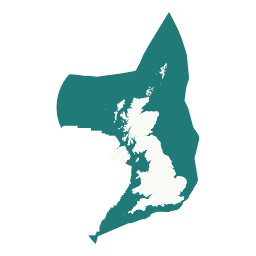
The UK Continental Shelf is a complex and changing marine environment. Useful information is spread across many sources, including bathymetry, offshore energy leases, petroleum licences, wells, pipelines, subsea infrastructure, cables, geology, wrecks, munitions, survey coverage, and metocean observations.
Keeping track of those sources can be difficult. Data often has to be found provider by provider, opened in separate portals, or brought into GIS before the wider context becomes clear. That can slow down early project screening, consenting work, cable and route planning, site selection, and general marine due diligence.
UKCS Data Atlas brings those open datasets into one place so they can be viewed, searched, queried, and exported more easily. The current atlas includes more than 90 source layers across the main UKCS themes, with further datasets planned. Source data is designed to be refreshed periodically, with weekly update checks used to keep the local cache current.
The atlas is for screening and awareness, not navigation, operational safety, legal boundary determination, or statutory advice. Source data remains subject to the original provider licences and attribution requirements; KIS-ORCA layers are shown for awareness and should be checked against the official KIS-ORCA downloads and terms.
Who Made It
UKCS Data Atlas was created and is independently maintained by pyramid146. It is an independent project built to make UKCS open data easier to discover, compare, and use for early-stage marine work.
What It Helps With
- Search and zoom to more than 100,000 named features across multiple open datasets.
- Search an area of interest and return relevant open datasets by theme and provider.
- Export matching data for an area of interest as GeoJSON, GeoPackage, and supporting report outputs.
- View recent WaveNet buoy observations where live data is available.
- Retrieve short modelled metocean time series for waves, currents, and wind from Copernicus Marine for a chosen location.
- Review dataset currency and update status through internal health and change-tracking tools.
Getting Started
- Use the layer tree to switch themes on and off. Legend links show the symbology and source currency where available.
- Use feature search to find named infrastructure, licences, cables, surveys, wells, wrecks, and other mapped records.
- Click a visible feature to open feature information, source links, and any available legend for that layer.
- Use Open Data Search when you want to ask “what open datasets exist in this area?” rather than inspect one map feature.
Areas Of Interest
- Create an AOI by setting a point and radius, drawing a polygon or line, creating a rectangle, or uploading WGS84 GeoJSON, GeoPackage, or zipped Shapefile data.
- Point and line searches use the chosen buffer distance. Rectangle searches use the width, height, and rotation entered by the user.
- Signed-in users can save AOIs and reuse them for later searches or update subscriptions.
Open Data Search
- Run a search from the current AOI to return matching datasets grouped by theme, such as licensing, infrastructure, geophysical, geotechnical, seismic, bathymetry, hazards, geology, and protected areas.
- Use the result drawer to review records, zoom to features, open source links, export matched vector data, download clipped bathymetry where available, or create a report.
- Exports include the AOI so the search context is preserved with the downloaded data.
Subscriptions
- Subscriptions notify users when tracked open data changes. They can be global, or limited to a saved AOI.
- To keep setup simple, subscriptions are selected by data source, such as NSTA, BGS, MDE, UKHO, KIS-ORCA, JNCC, NatureScot, or EMODnet.
- Centroid and label helper layers are excluded from change notifications because they are derived from source datasets.
Planned Additions
- AOI-specific update subscriptions, so users can be told when relevant datasets change near a saved project area.
- Saved user areas of interest and previous searches.
- More complete PDF reporting, including better map figures and source summaries.
- Additional open datasets where licensing and access terms allow them to be included.
More Information
Suggestions are welcome, especially for open datasets that would improve UKCS project screening or marine spatial context.
 UKCS DATA ATLAS